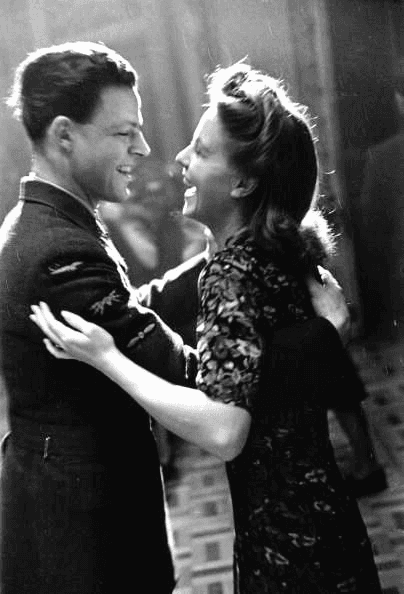
I have always been drawn to history, but not necessarily for the reasons people usually expect. I am not particularly fascinated by dates, military rankings, political speeches, or the question of who had the better strategy. What keeps pulling me back is something much smaller: what it must have actually felt like to be an ordinary person living through an extraordinary period of history.
The Second World War is perhaps the clearest example of this. We often experience it through documentaries, photographs, maps, famous battles, and the names of people who shaped it. But underneath all of that were millions of ordinary lives continuing in circumstances that none of them had chosen.
History From The Ground
When I think about the Second World War, I sometimes try to remove myself from the perspective of the history book and imagine the person standing inside it.
Imagine being twenty years old in 1939.
You have a family. You have friends. You have a job you probably don't particularly love but depend on. You know the streets around your home. You have favourite places. Maybe you have recently fallen in love. Maybe you are saving money for a car. Maybe you are thinking about marriage.
And then suddenly, the world begins changing around you.
The newspaper starts carrying different stories.
People begin talking about politics more seriously.
Men you know begin leaving.
Certain products become harder to find.
Conversations become quieter.
And gradually, something that once seemed distant becomes part of your everyday life.
That transition fascinates me more than the battles themselves.
When The Extraordinary Becomes Ordinary
One of the strangest things about human beings is how quickly we adapt.
Things that would have seemed unimaginable on Monday can become routine by Friday.
During wartime, people still had to wake up.
Shops still had to open.
Children still had to attend school when possible.
Farmers still had to work.
Mechanics still had to repair things.
Families still had to cook dinner.
People still celebrated birthdays.
People still fell in love.
People still laughed.
This does not make the war less serious. If anything, it makes the human side of it more powerful.
History did not stop because the world was at war.
Life continued inside it.
The Psychology Of Waiting
I think waiting must have been one of the most psychologically difficult parts of that period.
Waiting for a letter.
Waiting for news.
Waiting for someone to come home.
Waiting for the next announcement.
Waiting to find out whether the person you loved was safe.
Today, if someone doesn't respond to a message for several hours, we can become impatient. We have become accustomed to immediate information.
Imagine living in a world where a letter from someone you loved could take days or weeks to arrive, and the absence of a letter could mean absolutely anything.
I wonder what that did to people's minds.
Uncertainty became part of everyday life. People had to learn how to continue functioning without knowing what would happen next.
Small pieces of information became incredibly valuable. A letter, a photograph, a newspaper, or a conversation with someone who had recently arrived could completely change someone's emotional state.
Hope became practical. It was not simply an optimistic feeling. Sometimes hope was the only way to keep moving through another ordinary day.
The Importance Of Small Things
This is probably the part of history I find most beautiful.
Not beautiful because of the circumstances, but because of what people still managed to preserve.
A family photograph.
A handwritten letter.
A favourite recipe.
A song played on the radio.
A Sunday meal.
A conversation with a neighbour.
A child's drawing.
A few belongings carefully kept in a drawer.
These things might seem insignificant when compared with the enormous events happening around them.
But when everything else becomes uncertain, ordinary things become anchors.
Sometimes the smallest routines are what remind us that we are still ourselves.
The Young People Who Became Adults Too Quickly
Another thing I think about often is how many young people had their understanding of adulthood completely transformed.
Imagine being eighteen or nineteen and suddenly having responsibilities that normally belong to someone much older.
You are expected to make decisions.
To leave home.
To become independent.
To take care of other people.
To experience fear without necessarily having the language to explain it.
There must have been an enormous psychological distance between the person you were before and the person you became afterward.
And yet, when the war ended, life expected people to continue.
What Happens After History Ends?
This is one of the questions that interests me most.
We often talk about 1945 as though the story simply reaches its conclusion.
The war ends.
The flags come down.
The soldiers return.
The history book moves to the next chapter.
But for ordinary people, there was no clean ending.
Houses had to be rebuilt.
Businesses had to reopen.
Families had to understand who was coming home and who wasn't.
Cities had to become cities again.
People had to learn how to live without constantly expecting the next crisis.
Rebuilding More Than Buildings
I find the period after the war incredibly interesting because rebuilding was not only physical.
Europe had to rebuild its streets, factories, homes and infrastructure.
But people also had to rebuild their sense of normality.
Imagine spending years believing that uncertainty was normal and then suddenly being told that peace had arrived.
What does peace feel like after you have become accustomed to fear?
What does an ordinary morning feel like when you finally realise that nothing is expected to happen?
Perhaps at first, peace itself must have felt unfamiliar.
What History Makes Me Think About
The more I read about the period, the less interested I become in simply remembering what happened and the more interested I become in understanding what it meant to the people who experienced it.
History makes me think about how fragile normal life actually is.
We complain about ordinary routines because they can feel repetitive.
But there is something incredibly valuable about repetition.
Waking up in the same house.
Going to the same job.
Seeing the same people.
Eating dinner with your family.
Driving the same road home.
These things feel boring precisely because they are stable.
And perhaps stability is one of the greatest luxuries we rarely notice.
The Perspective I Take Away
I do not think about the Second World War because I want to live in that period.
Quite the opposite.
I think about it because it makes me appreciate the period I live in.
The ability to call someone instantly.
The ability to travel freely.
The ability to sit at home and feel safe.
The ability to complain about an ordinary Monday.
Even the freedom to be bored.
These are things that become invisible when we have always had them.
History has a strange way of making ordinary life feel extraordinary.
Perhaps that is why I keep returning to it.
Not to admire the war.
Not to romanticise suffering.
But to remember the people who existed inside the dates and statistics.
People who had plans.
People who had favourite songs.
People who worried about money.
People who loved someone.
People who wanted to go home.
People who simply wanted tomorrow to look a little more normal than today.
And maybe that is what history ultimately gives me.